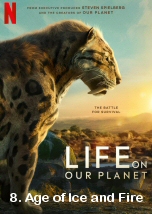
The final episode begins with a description of the extreme cold conditions that characterized the beginning of the Holocene period, and how species like the bison and the wolf adapted to survive in these hostile environments. We will witness the majesty of the woolly mammoth and the fierce cave lion, with a vivid reconstruction of their struggles for survival. We'll see the impact of climate change during this period, from the expansion of the deserts to the transformation of the tropical rainforests of Africa into grasslands, deeply affecting primates and other animals. It highlights how these changes forced primates to adapt to life on the ground, facing new challenges and predators. A crucial turn occurred with the emergence of humans as dominant predators and their influence on the extinction of large mammals. The documentary describes humanity's transition from hunter-gatherers to farmers, a change that radically altered the landscape and biodiversity of the planet. Finally, it poses a reflection on the current challenges of climate change and the sixth mass extinction, inviting viewers to consider humanity's crucial role in shaping the future of the Earth.
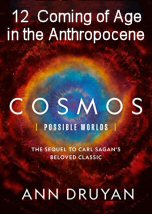
At 11 o'clock on New Year's Eve of the Cosmic Calendar, Homo erectus stood up for the first time, freeing its hands and earning the species its name. They began to move around, to explore, daring to risk everything to get to unknown places. Our Neanderthal relatives lived much as we did and did many of the things we consider to be 'human.' More restless than their cousins the Neanderthals and Denisovans, our Homo sapiens ancestors crossed seas and unforgiving landscapes, changing the land, ocean and atmosphere, leading to mass extinction. The scientific community gave our age a new name, 'Anthropocene.' Since the first civilizations we've wondered if there's something about human nature that contains the seeds of our destruction. Syukuro Manabe was born in rural Japan and took an intense interest in Earth's average global temperature. In the 1960's, he would assemble the evidence he needed to predict the increase of Earth's temperature due to greenhouse gases until it becomes an uninhabitable and toxic environment, leading to our extinction. 'This doesn't have to be,' says Neil deGrasse Tyson, 'it's not too late. There's another hallway, another future we can still have; we'll find a way.'
A team of Australian and Chinese scientists discover mysterious ancient human remains from a remote cave in South West China. The bones are unlike any living human or any ancient human known to science, yet they were alive at the same time as humans of our own kind. Could they represent a new human species? And if so, what happened to these people?
Spanning five gripping episodes presented together in one seamless video, this sweeping journey explores 300,000 years of human evolution, revealing groundbreaking discoveries that are reshaping everything we thought we knew about our origins. From the first appearance of Homo sapiens in Africa—at a time when at least six other human species walked the Earth—to the dramatic encounters with Neanderthals and the mysteries of their disappearance, each chapter uncovers the epic struggle for survival and dominance. As the Ice Age grips the planet, humanity pushes into the Americas, braving the harshest conditions in history. Finally, as the ice recedes, a transformation begins: the shift from wandering hunters to the builders of the first permanent settlements. This story brings to life the triumphs, dangers, and defining moments that made us who we are today.
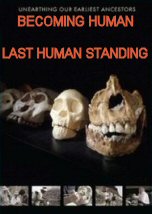
xamines the fate of the Neanderthals, our European cousins who died out as modern humans spread from Africa into Europe during the Ice Age. Did modern humans interbreed with Neanderthals or exterminate them? The program explores crucial evidence from the recent decoding of the Neanderthal genome. How did modern humans take over the world? New evidence suggests that they left Africa and colonized the rest of the globe far earlier, and for different reasons, than previously thought. As for Homo sapiens, we have planet Earth to ourselves today, but that's a very recent and unusual situation. For millions of years, many kinds of hominids co-existed. At one time Homo sapiens shared the planet with Neanderthals, Homo erectus, and the mysterious "Hobbits"–three-foot-high humans who thrived on the Indonesian island of Flores until as recently as 12,000 years ago. "Last Human Standing" examines why "we" survived while those other ancestral cousins died out. And it explores the provocative question: In what ways are we still evolving today?
40,000 years ago the steppes of Eurasia were home to our closest human relative, the Neanderthals. Recent genetic and archaeological discoveries have proven that they were not the dim-witted cave dwellers we long thought they were. In fact, they were cultured, technologically savvy and more like us than we ever imagined! So why did they disappear? We accompany scientists on an exciting search for an answer to this question and come to a startling conclusion... A climate change due to a cataclysmic event.

























A crucial turn occurred with the emergence of humans as dominant predators and their influence on the extinction of large mammals. The documentary describes humanity's transition from hunter-gatherers to farmers, a change that radically altered the landscape and biodiversity of the planet. Finally, it poses a reflection on the current challenges of climate change and the sixth mass extinction, inviting viewers to consider humanity's crucial role in shaping the future of the Earth.