Everywhere you go, you generate a cloud of data. You're trailing data, everything that you do is producing data. And then there are computers looking at that data that are learning, and these computers are essentially trying to serve you better. They're trying to personalize things to you. They're trying to adapt the world to you. So on the one hand, this is great, because the world will get adapted to you without you even having to explicitly adapt it. There's also a danger, because the entities in the companies that are in control of those algorithms don't necessarily have the same goals as you, and this is where I think people need to be aware that, what's going on, so they can have more control over it. We came into this new world thinking that we were users of social media and search engines. It didn't occur to us that social media and search engines were actually using us.
Frequent security expos feature companies like Megvii and its facial- recognition technology. They show off cameras with A.I. that can track cars, and identify individuals by face, or just by the way they walk. In China it's been projected that over 600 million cameras will be deployed by 2020. Here, they may be used to discourage jaywalking, but they also serve to remind people that the state is watching. Matching with the most advanced artificial intelligence algorithm, they can actually use this data, real-time data, to pick up a face or pick up a action. A.I. is a technology that can be used for good and for evil. So, how do governments limit themselves in, on the one hand, using this A.I. technology and the database to maintain a safe environment for its citizens, but not to encroach on a individual's rights and privacies?
What connects amateur sleuths turning up at crime scenes, anti-social behaviour in schools and riots? Marianna Spring has spent one year investigating harmful behaviour on TikTok spilling out into the real-world. As well as crunching the numbers, Marianna tracks down TikTok users, victims and former employees to interrogate and expose how extremely high engagement on TikTok around particular topics appears to be creating these 'frenzies'. The documentary explores how users go to extreme lengths in order to get more engagement in a battle for followers and likes. Marianna investigates the role TikTok's algorithm and format plays in what’s happening and reveals insiders’ concerns about the app. The film seeks to find out if this is the real danger and what impact it is having on society.
In 1901, a group of divers excavating an ancient Roman shipwreck near the island of Antikythera, off the southern coast of Greece, found a mysterious object - a lump of calcified stone that contained within it several gearwheels welded together after years under the sea. The 2,000-year-old object, no bigger than a modern laptop, is now regarded as the world's oldest computer, devised to predict solar eclipses and, according to recent findings, calculate the timing of the ancient Olympics. Following the efforts of an international team of scientists, the mysteries of the Antikythera Mechanism are uncovered, revealing surprising and awe-inspiring details of the object that continues to mystify
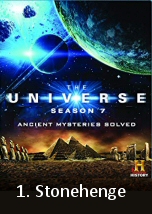
Perhaps the most mysterious structure on Earth, Stonehenge has stood on a plain in Southern England for 5000 years. Its foundations predate the Great Pyramids. It is one of mankind's most ancient mysteries. Why is it here? Is it a temple? A burial ground? A place for sacrifice? Or could the mystery of Stonehenge be revealed in its builders' desire to explore the unknown heavens and touch the universe? Using the cutting-edge computer-generated imagery that takes us into deep space, we'll also go inside a virtual Stonehenge to see what the ancients saw and push this prehistoric marvel to give up its age-old secrets. In this episode we explore the possibility that this was a prehistoric astronomical observatory. Here ancient astronomer priests may have divined the complex movements of the Sun and Moon, recognizing patterns that would not be discovered elsewhere for thousands of years. The primitive Shamans may have also been the first astronomers to predict eclipses.
Super quick computers and advanced mathematical formulas have taken over trading on the financial markets from human beings -algorithms- which seem to have a life of their own. The only ones who understand the system in any way are its architects, the algorithm developers. Haim Bodek is one such algo-developer. After finding some strange wrongdoings he set out on a personal crusade against this elusive system". The machinery behind our financial markets, consisting of mathematical models, data centers and miles and miles of fiber optic cables, is disguised by technological complexity and secrecy. The builders of this financial system are a new breed of Wall Street employees -quants- mathematicians and physicists who are responsible for a technological revolution. Haim Bodek is a quant; he specialized in artificial intelligence and worked for Goldman Sachs. He knows the system from the inside, he helped build it. Haim Bodek was invited to tell his story at the "Battle of the Quants" - a recurring event where quants discuss high-frequency trading, amongst other things. Bodek wrote an algorithm for trading machines that would generate guaranteed income - a money machine that weathered the financial meltdown of 2008. But then from one day to the next the algorithm stopped working.


























We came into this new world thinking that we were users of social media and search engines. It didn't occur to us that social media and search engines were actually using us.