Deep beneath the Indian Ocean, a team of explorers embarks on a bold scientific mission to capture one of nature’s rarest survivors — the coelacanth, a fish unchanged for 400 million years. Narrated by David Attenborough, the film follows NHK’s deep-sea crew aboard the OceanX vessel as they attempt the world’s first 72-hour observation of this living fossil. Using cutting-edge submersibles, they descend into an ancient realm where time itself seems frozen. As the cameras reveal the coelacanth’s slow, graceful movements, scientists uncover vital clues about evolution’s greatest leap — the moment life crawled from sea to land. Blending adventure, technology, and breathtaking natural history, this deep-ocean odyssey illuminates how a single fish still holds the key to understanding our own beginnings.
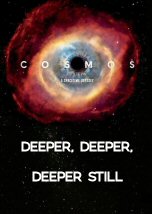
This episodes the nature of the cosmos on the micro and atomic scales, using the Ship of the Imagination to explore these realms. Tyson describes some of the micro-organism that live within a dew drop, demonstrating parameciums and tardigrades. He proceeds to discuss how plants use photosynthesis via their chloroplasts to convert sunlight into chemical reactions that convert carbon dioxide and water into oxygen and energy-rich sugars. Tyson then discusses the nature of molecules and atoms and how they relate to the evolution of species. He uses the example set forth by Charles Darwin postulating the existence of the long-tongued Morgan's sphinx moth based on the nature of the comet orchid with pollen far within the flower. He further demonstrates that scents from flowers are used to trigger olfactory centers in the brain, stimulating the mind to threats as to aid in the survival of the species. Tyson narrates how Greek philosophers Thales and Democritus postulated that all matter was made up of combinations of atoms in a large number of configurations, and describes how carbon forms the basic building block for life on earth due to its unique chemical nature. Tyson explains on the basic atomic structure of protons, neutrons, and electrons, and the nature of nuclear fusion that occurs in most stars. He then discusses the existence of neutrinos that are created by these nuclear processes in stars, and that detecting such sub-atomic particles which normally pass through matter require subterranean facilities like the Super-Kamiokande that were used to detect neutrinos from the supernova SN 1987A in the Large Magellanic Cloud before light from the explosion were observed due to their ability to pass through matter of the dying sun. Tyson compares how neutrinos were postulated by Wolfgang Pauli to account for the conservation of energy from nuclear reactions in the same manner as Darwin's postulate on the long-tongued moth. Tyson concludes by noting that there are neutrinos from the Big Bang still existing in the universe but due to the nature of light, there is a "wall of infinity" that cannot be observed beyond.
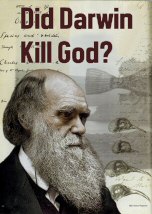
There are some who believe that Darwin's theory of evolution has weakened religion. Conor Cunningham argues that nothing could be further from the truth.He travels to the Middle East where he shows that from the very outset, Christianity warned against literal readings of the biblical story of creation. In Britain, he reveals that, at the time, Darwin's theory of evolution was welcomed by the Anglican and Catholic Churches. Instead, he argues that the conflict between Darwin and God was manufactured by American creationists in the 20th century for reasons that had very little to do with science and religion and a great deal to do with politics and morality. Finally, he comes face to face with some of the most eminent evolutionary biologists, geneticists and philosophers of our time to examine whether the very
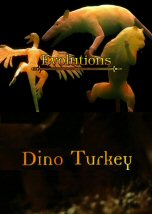
From small viscous meat eaters to vegetarian giants, dinosaurs came in all shapes and sizes. Remarkable new evidence suggests that one dinosaur did not become extinct but evolved into a new animal species we all know today. Discover the missing link between the velociraptor and modern day birds.
Alex Winter explores the downloading revolution; the kids that created it, the bands and the businesses that were affected by it, and its impact on the world at large. He focuses on the advent of digital media sharing, including the rise of game-changing company Napster and controversial pioneers Shawn Fanning and Sean Parker. The digital revolution ultimately created a technology paradigm shift and upended the music industry. Audiences will hear insight from well known music artists and figures within the music industry including: The Beastie Boys' Mike D, Noel Gallagher, Henry Rollins, former Sony Music Chairman, Don Ienner, former record producer and Island Records founder Chris Blackwell and Hilary Rosen, former CEO of the Recording Industry Association of America.
About 340 million years ago a brand new family of animals was evolving in the primeval swamps. They were to go one step further than the amphibians who had emerged onto dry and before them. For they would eventually completely cut their ties with water. They were the ancestors of todays lizards. They evolved scaly impermeable skins and moved up into the forests. They diversified into a multitude of different shapes and sizes. They developed signalling systems to communicate with one another. And they squabbled as animals do. For food they hunted insects that were already well established on the land in great numbers. And here without returning to water they produced their families. They powered their bodies not only with food but with the heat that they drew directly from the sun.
As they diversified so they spread into the harshest of the lands habitats. The baking waterless deserts which eventually they would come to dominate. Discover jacky lizards that wave, wrestling beaded lizards and the the world's smallest chameleon, which is no bigger than his thumbnail, and the biggest lizard in Australia.























As the cameras reveal the coelacanth’s slow, graceful movements, scientists uncover vital clues about evolution’s greatest leap — the moment life crawled from sea to land. Blending adventure, technology, and breathtaking natural history, this deep-ocean odyssey illuminates how a single fish still holds the key to understanding our own beginnings.