

Last Watched

"House"  Sort by

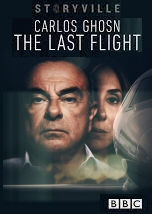
Carlos Ghosn The Last Flight

   2021    History
Carlos Ghosn – the former CEO of the Renault-Nissan Alliance, charged with financial crimes – stunned the world with his escape from Japan. Nick Green’s documentary sheds light on this multilayered story, drawing out a portrait of a fascinating character and explaining his escape to Lebanon without a passport and while he was still under house arrest.
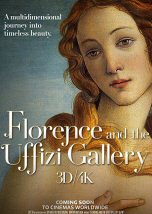
Florence and the Uffizi Gallery

       Art    3D    HD
This film is a multi-dimensional journey through the city that was once the cradle of the Italian Renaissance. Get an exclusive tour through the most beautiful and representative works of art of the period from Michelangelo and Brunelleschi, to Leonardo and Botticelli, with a detailed central chapter dedicated to the very treasure house containing their masterpieces: the Uffizi Gallery. This also includes the breathtaking 'Adoration of the Mag' by Leonardo Da Vinci, which, after several years of restoration, will be brought back to life and unveiled in this worldwide exclusive premiere on the big screen.

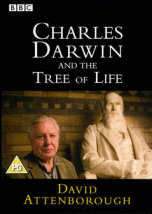
Charles Darwin and the Tree of Life

   2009    Science
David Attenborough asks three key questions: how and why did Darwin come up with his theory of evolution? Why do we think he was right? And why is it more important now than ever before? David starts his journey in Darwin's home at Down House in Kent, where Darwin worried and puzzled over the origins of life. David goes back to his roots in Leicestershire, where he hunted for fossils as a child, and where another schoolboy unearthed a significant find in the 1950s. And he revisits Cambridge University, where both he and Darwin studied, and where many years later the DNA double helix was discovered, providing the foundations for genetics. At the end of his journey in the Natural History Museum in London, David concludes that Darwin's great insight revolutionised the way in which we see the world. We now understand why there are so many different species, and why they are distributed in the way they are. But above all, Darwin has shown us that we are not set apart from the natural world, and do not have dominion over it. We are subject to its laws and processes, as are all other animals on earth to which, indeed, we are related.

Earth, the Power of the Planet: Atmosphere

   2007    Nature
The series highlights the major events which have shaped the Earth's history and allowed life to flourish. Follow Dr Stewart's personal journey to some of the most remote places on the planet. The atmosphere is Earth’s protective layer, cloaking us in a warm, oxygen-rich embrace and shielding us from the cold hostility of space. It acts as a natural greenhouse, keeping the Earth 51 degrees Fahrenheit warmer than it would otherwise be. Yet the atmosphere is also full of contradictions. It’s immensely powerful but at the same time highly sensitive. It’s destructive, yet it shelters us. It was created in part by the planet’s first organisms, and it continues to be essential for life.
Series: Earth, the Power of the Planet

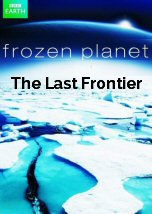
Frozen Planet: The Last Frontier

   2011    Culture
The documentary series reveals the extraordinary riches and wonders of the Polar Regions that have kept people visiting them for thousands of years. Today, their survival relies on a combination of ancient wisdom and cutting-edge science. Most Arctic people live in Siberia, either in cities like Norilsk - the coldest city on earth - or out on the tundra, where tribes like the Dogan survive by herding reindeer, using them to drag their homes behind them. On the coast, traditional people still hunt walrus from open boats - it is dangerous work, but one big walrus will feed a family for weeks. Settlers are drawn to the Arctic by its abundant minerals; the Danish Armed Forces maintain their claim to Greenland's mineral wealth with an epic dog sled patrol, covering 2,000 miles through the winter. Above, the spectacular northern lights can disrupt power supplies so scientists monitor it constantly, firing rockets into it to release a cloud of glowing smoke 100 kilometres high. In contrast, Antarctica is so remote and cold that it was only a century ago that the first people explored the continent. Captain Scott's hut still stands as a memorial to these men. Science is now the only significant human activity allowed; robot submarines are sent deep beneath the ice in search of new life-forms, which may also be found in a labyrinth of ice caves high up on an active volcano. Above, colossal balloons are launched into the purest air on earth to detect cosmic rays. At the South Pole there is a research base designed to withstand the world's most extreme winters. Cut off from the outside world for six months, the base is totally self-sufficient, even boasting a greenhouse.
Series: Frozen Planet

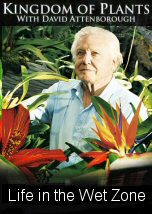
Kingdom of Plants Life in the Wet Zone

   2012    Nature
Written and presented by David Attenborough, who said: 'One of the most wonderful things about filming plants is that you can reveal hidden aspects of their lives, you can capture the moment as one plant strangles another, and as they burst into flower. But whilst time-lapse photography allows you to see things that no human being has ever seen before". David begins his journey inside the magnificent Palm House, a unique global rainforest in London. Here, he explores the extraordinary plants that are so well adapted to wet and humid environments and unravels the intimate relationships between wet zone plants and the animals that depend on them. It was in the wet zones of the world that plants first moved on to land and in the Waterlily House David reveals how flowers first evolved some 140 million years ago. Watching a kaleidoscope of breath-taking time-lapses of these most primitive of flowers swelling and blooming in 3D, he is able to piece together the very first evolutionary steps that plants took to employ a wealth of insects to carry their precious pollen for the first time. David discovers clues to answer a question that even had Charles Darwin stumped: how did flowering plants evolve so fast to go on to colonise the entire planet so successfully?
Series: Kingdom of Plants