Last Watched

"Islam"  Sort by

The Virus of Faith

   2006    Culture
Dawkins opines that the moral framework of religions is warped, and argues against the religious indoctrination of children. He discusses specifically the idea of religion seen as a virus in the sense of a meme. He begins by explaining how a child is genetically programmed to believe without questioning the word of authority figures, especially parents – the evolutionary imperative being that no child would survive by adopting a sceptical attitude towards everything their elders said. But this same imperative, he claims, leaves children open to infection by religion.
Series: The Root of All Evil
Words on a Page

   2020    History
Writing itself is 5,000 years old, and for most of that time words were written by hand using a variety of tools. The Romans were able to run an empire thanks to documents written on papyrus. Scroll books could be made quite cheaply and, as a result, ancient Rome had a thriving written culture. With the fall of the Roman Empire, papyrus became more difficult to obtain. Europeans were forced to turn to a much more expensive surface on which to write: Parchment. Medieval handwritten books could cost as much as a house, they also represent a limitation on literacy and scholarship.
No such limitations were felt in China, where paper had been invented in the second century. Paper was the foundation of Chinese culture and power, and for centuries how to make it was kept secret. When the secret was out, paper mills soon sprang up across central Asia. The result was an intellectual flourishing known as the Islamic Golden Age. Muslim scholars made discoveries in biology, geology, astronomy and mathematics. By contrast, Europe was an intellectual backwater.
That changed with Gutenberg’s development of movable type printing. The letters of the Latin alphabet have very simple block-like shapes, which made it relatively simple to turn them into type pieces. When printers tried to use movable type to print Arabic texts, they found themselves hampered by the cursive nature of Arabic writing. The success of movable type printing in Europe led to a thousand-fold increase in the availability of information, which produced an explosion of ideas that led directly to the European Scientific Revolution and the Industrial Revolution that followed.
Series: The Secret History of Writing

The Clash of Titans

   2012    History
The most famous – and perhaps most misunderstood – episodes in the epic history of the Holy Wars that are known to history as The Crusades – the clash between Richard the Lionheart and Saladin. In July 1192, Richard the Lionheart stood poised for a strike on Jerusalem, while Saladin – mighty sultan of Islam – readied his troops inside the city, preparing for the inevitable attack. During a year-long campaign across Palestine, these two legendary leaders had fought each other to a stand-still. Thousands had perished, appalling atrocities had been perpetrated on both sides. And now they faced each other in a battle for their sacred objective.
Series: The Crusades

Among Believers

   2013    History
With optional Hebrew subtitles. The story of medieval Jews struggling to preserve their identity--and sometimes their lives--under the rule of Christianity and Islam. Whether labelled 'Christ-killers' by the Christians or 'dhimmi' (non-Muslim citizens of an Islamic community) by the Muslims, diaspora Jews built new lives and invented new ways of being Jewish in exile in the face of discrimination, blood-libels and persecution interspersed with periods of tolerance, protection and peaceful co-existence. Drawing on some of the documents they left behind, this episode offers a vivid portrait of Jewish bankers, merchants, doctors, poets and artists flourishing in Lincoln, Cordoba, Venice and Cairo and tells the story of their mass expulsion from Spain in 1492.
Series: The Story of the Jews

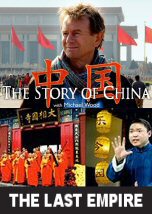
The Last Empire

   2016    History
China's last empire, the Qing, lasted from 1644 to 1912. It began in violence and war as the Manchus swept down from the north, but invaders became emperors, with three generations of one family ruling the country. Among them, Michael Wood argues, was China's greatest emperor - Kangxi. Under the Qing, China doubled in size to include Xinjiang in the far west, as well as Mongolia and Tibet, creating the essential shape of China today. The new dynasty tolerated a diversity of cultures and religions, including Islam. In Kaifeng, Michael visits a women's mosque with a female imam, a delightful scene that ends with laughter and selfies! The Qing also undertook huge cultural enterprises. At a traditional printing house where the wood blocks are hand-carved, we see how the Complete Tang Poems were reproduced - all 48,000 of them. We travel through the wintry countryside to a remote village where a hardy audience watch open-air opera in the snow and visit a painter's studio, and 'storytelling' houses in Yangzhou. In the 18th century, China was arguably the greatest economy in the world, and we get a fabulous sense of the rich culture that came with prosperity. But then came the clash with the British, in the first Opium War, when a British expedition destroyed the Qing navy and extracted territory and trading rights. We leave with a glimpse of the future. 'Every dynasty has risen and declined,' says Michael, 'and has needed new life to regenerate, and this time the catalyst was the British.' Among the ports China ceded was an almost uninhabited island, Hong Kong, one of today's greatest financial centres, and Shanghai, a small town then but now one of the greatest cities in world.
Series: The Story of China

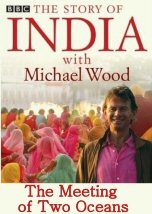
The Story of India: The Meeting of Two Oceans

   2007    History
Michael Wood charts the coming of Islam to the subcontinent and one of the greatest ages of world civilisation: the Mughals. He visits Sufi shrines in Old Delhi, desert fortresses in Rajasthan and the cities of Lahore and Agra, where he offers a new theory on the design of the Taj Mahal. He also looks at the life of Akbar, a Muslim emperor who decreed that no one religion could hold the ultimate truth, but whose dream of unity ended in civil war.
Series: The Story of India
Wild Russia

Wild Russia

2009  Nature
Art of Eternity

Art of Eternity

2007  Art
Clash of the Gods

Clash of the Gods

2009  History
How Earth Made Us

How Earth Made Us

2010  Science
Arnold

Arnold

2023  History
The Planets

The Planets

2000  Science
Dirty Money

Dirty Money

2018  Culture