The film challenges many of the commonly held assumptions about our water systems and how people think about water. Its goal is to bust the global sense of impending doom by painting an alternative, optimistic water future and mapping out the ways to get there. The filmmakers believe that even one person with enough knowledge can make a difference and inspire a movement. The film tries to provide that knowledge and to envision a day when everybody has access to clean water and sanitation and in our lifetime. Narrated by Liam Neeson, featuring Matt Damon and Jaden Smith, 'Brave Blue World' paints an optimistic picture of how humanity is adopting new technologies and innovations to re-think how water is managed.
Professor Alice Roberts journeys 40,000 years back in time on the trail of the great beasts of the Ice Age. Drawing on the latest scientific detective work and a dash of graphic wizardry, we bring the Ice Age Giants back to life. The series begins in the 'land of the sabre-tooth'; North America, a continent that was half covered by ice that was up to two miles thick. Yet this frozen land also boasted the most impressive cast of Ice Age giants in the world. Across locations such as the Grand Canyon, the sands of Arizona and the coast of California, Alice traces the movements of Ice Age beasts like bear-sized sloths, vast mammoths and the strange beast known as the glyptodon. These leviathans all have one thing in common: they were stalked by the meanest big cat that ever prowled the Earth, armed with seven-inch teeth and hunting in packs - Smilodon fatalis, the sabre-toothed cat.
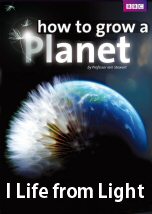
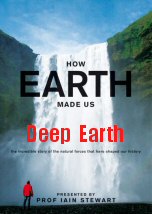
Our planet has amazing power, and yet that's rarely mentioned in our history books. This series tells the story of how the Earth has influenced human history, from the dawn of civilisation to the modern industrial age. It reveals how geology, geography and climate have been a far more powerful influence on the human story than has previously been acknowledged. A combination of epic story telling, visually stunning camerawork, extraordinary locations and passionate presenting combine to form a highly original version of human history" In the first episode professor Iain Stewart explores the relationship between the deep Earth and the development of human civilisation. He visits an extraordinary crystal cave in Mexico, drops down a hole in the Iranian desert and crawls through seven-thousand-year-old tunnels in Israel. His exploration reveals that throughout history, our ancestors were strangely drawn to fault lines, areas which connect the surface with the deep interior of the planet. These fault lines gave access to important resources, but also brought with them great danger.
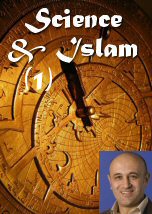
Physicist Jim Al-Khalili travels through Syria, Iran, Tunisia and Spain to tell the story of the great leap in scientific knowledge that took place in the Islamic world between the 8th and 14th centuries. Its legacy is tangible, with terms like algebra, algorithm and alkali all being Arabic in origin and at the very heart of modern science - there would be no modern mathematics or physics without algebra, no computers without algorithms and no chemistry without alkalis. For Baghdad-born Al-Khalili, this is also a personal journey, and on his travels he uncovers a diverse and outward-looking culture, fascinated by learning and obsessed with science. From the great mathematician Al-Khwarizmi, who did much to establish the mathematical tradition we now know as algebra, to Ibn Sina, a pioneer of early medicine whose Canon of Medicine was still in use as recently as the 19th century, Al-Khalili pieces together a remarkable story of the often-overlooked achievements of the early medieval Islamic scientists.
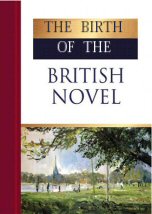
Author Henry Hitchings explores the lives and works of Britain's radical and pioneering 18th-century novelists who, in just 80 years, established all the literary genres we recognise today. It was a golden age of creativity led by Daniel Defoe, Jonathan Swift, Henry Fielding, Laurence Sterne, Fanny Burney and William Godwin, amongst others. Robinson Crusoe, Gulliver's Travels, Tom Jones and Tristram Shandy are novels that still sparkle with audacity and innovation. On his journey through 18th-century fiction, Hitchings reveals how the novel was more than mere entertainment, it was also a subversive hand-grenade that would change British society for the better. He travels from the homes of Britain's great and good to its lowliest prisons, meeting contemporary writers like Martin Amis, Will Self, Tom McCarthy and Jenny Uglow on the way.
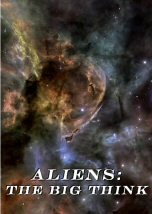
The hunt for aliens is on! After a distinguished career in cosmology Professor Martin Rees, the astronomer royal, has taken up the search for extra-terrestrials. Looking for aliens is no longer science fiction - it is a question that's engaging some of the greatest minds in science." As our knowledge of the universe has increased, we're getting closer to answers. Many scientists now think we live in galaxy with a billion Earth-like planets, many of which may be teeming with life. But what kind of life? Has anything evolved into beings we could communicate with? This film gets inside the minds of the scientists considering one of the most exciting and profound questions we can ask - are we alone in the universe? Professor Rees thinks we may have our idea of what an alien is like all wrong. If he's right, it's not organic extra-terrestrials we should look for, it's machines.










Narrated by Liam Neeson, featuring Matt Damon and Jaden Smith, 'Brave Blue World' paints an optimistic picture of how humanity is adopting new technologies and innovations to re-think how water is managed.