





Last Watched

"Germany"  Sort by

To the Bitter End

   2007    History
The determination of the German forces to keep on fighting in the face of defeat had disastrous consequences. After the Allied landings in the summer of 1944, the Wehrmacht was on the defensive on all fronts. It was clear to the German generals interned at Trent Park that Germany would soon lose the war. In mid-1944, Gerhard Graf von Schwerin chose to use common sense instead of blindly obeying Hitler's orders. He decided to surrender the city of Aachen to the US army to avoid bloodshed. Other commanders such as Field Marshal Ferdinand Schorner kept on pushing their soldiers to give their all. Despite being outnumbered by the Soviet forces, Schorner forced his soldiers to hold out in Sworbe, a 200 square kilometre peninsula on the coast of Estonia. Thousands of soldiers died. Yet Schorner's attitude and the urging by Hitler and Goebbels to hold out were accepted by a large number of young soldiers. By April 1944, the Ruhr pocket was completely surrounded, yet Field Marshal Model refused to surrender, so that 1.2 million German soldiers and a large number of Allied soldiers died between January and May 1945.
Series: The Wehrmacht

Wild Wild Country Part Six

   2018    Culture
With increasing rumours of a pending arrest intensified, the Bhagwan flees the ranch. The two Learjets carrying Rajneesh and ten of his followers lands at the Charlotte airport, where U.S. police were waiting for them. The United States Marshals Service arrests Rajneesh. Almost simultaneously, Sheela and several followers are also arrested in Germany. In a federal court in Portland, Bhagwan Shree Rajneesh pleads guilty to immigration fraud charges and agrees to leave the country. The Bhagwan's devotees -- and his enemies -- reflect on his legacy.
Series: Wild Wild Country

Resistance

   2007    History
Among the ranks of the Wehrmacht there was limited opposition to Hitler. Most officers initially felt enthusiastic about the prospect of war and were grateful to Hitler whose war-mongering had furthered their personal careers. Furthermore all soldiers had to make an oath of allegiance to the Führer and, up until the very end, there were many who felt unable to break this pledge. There were, however, some officers who opposed Hitler. For some it was on moral grounds and for others because they thought that his military tactics would lose them the war. There were plots against Hitler and attempted coups, the best known being the July bomb plot led by Claus von Stauffenberg. Some soldiers refused to bear arms and were shot, others deserted, others still carried out quiet acts of sabotage and subversion. By and large, however, the Wehrmacht carried out the orders Hitler issued, even if it involved perpetrating acts of atrocity.
Series: The Wehrmacht

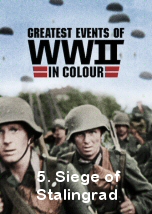
Siege of Stalingrad

   2020    History
Mid-1942, as Hitler’s forces are pushing into southern Russia to take the oilfields, he spies a city prized by his enemy Stalin – Stalingrad. If Hitler can capture this city, he can expand his empire all the way to the Urals. But what Hitler hasn’t counted on is the enormous resilience of the Soviet people; men and women willing to defend their Motherland at all costs.
What ensues at Stalingrad is one of the bloodiest battles in the history of warfare, with an estimated 2 million total casualties, and an event that turns the tide for the Germans.
Series: Greatest Events of WWII in Colour

Expanded Horizons

   2018    Science
Dr Hannah Fry travels down the fastest zip wire in the world to learn more about Newton's ideas on gravity. His discoveries revealed the movement of the planets was regular and predictable. James Clerk Maxwell unified the ideas of electricity and magnetism, and explained what light was. As if that wasn't enough, he also predicted the existence of radio waves. His tools of the trade were nothing more than pure mathematics. All strong evidence for maths being discovered.
But in the 19th century, maths is turned on its head when new types of geometry are invented. No longer is the kind of geometry we learned in school the final say on the subject. If maths is more like a game, albeit a complicated one, where we can change the rules, surely this points to maths being something we invent - a product of the human mind. To try and answer this question, Hannah travels to Halle in Germany on the trail of perhaps one of the greatest mathematicians of the 20th century, Georg Cantor. He showed that infinity, far from being infinitely big, actually comes in different sizes, some bigger than others. This increasingly weird world is feeling more and more like something we've invented. But if that's the case, why is maths so uncannily good at predicting the world around us? Invented or discovered, this question just got a lot harder to answer.
Series: Magic Numbers

The Relic that Sees the Future

   2021    History
A bizarre 3,000 year-old gold relic crafted with intricately designed cryptic patterns is believed to form a highly complex celestial code; using advanced imaging technology, experts speculate that it could be an ancient device for predicting the future.
Professor Timothy Koeth at Maryland University received a package containing a curiously heavy two-inch black cube. It comes with a message: "Taken from Germany from the nuclear reactor that Hitler tried to build."
Series: Strangest Things
How Earth Made Us

How Earth Made Us

2010  Science
Arnold

Arnold

2023  History
The Planets

The Planets

2000  Science
Dirty Money

Dirty Money

2018  Culture
Vegan

Vegan

2020  Culture
Dark Net

Dark Net

2016  Technology
Secrets of the Dead

Secrets of the Dead

2017  History