
Last Watched

"UK"  Sort by

Alternative Voices

   2021    Art
The 1980s was a time when artists in both the UK and US were delivering powerful social commentary in their songs. Dylan Jones selects some of the finest alternative voices from this era. From The Cure on Top of the Pops at the beginning of the decade to The Stone Roses' debut TV performance in 1989, this episode takes a comprehensive look at the alternative music of an entire era. It also features powerful live performances from Billy Bragg, Tracy Chapman, Bronski Beat and The Selecter. In addition, there are archival gems from Pixies, The Smiths, Suzanne Vega, The Fall, REM and many more.
Series: The 80s: Greatest Music Decade

The Sacrifice of Cassini

   2020    Technology
The 8th episode reviews Giovanni Cassini's life. His observations of Saturn and its moons would have an enduring effect on the scientific world. Neil deGrasse Tyson also narrates the mysterious untold story of the scientist who figured out how to go the Moon while fighting for his life in a WWI trench. Aleksandr Shargei changed his name to Yuri Kondratyuk out of fear for his life and wrote a manuscript on rocket motion and space colonization. This letter would end up capturing the attention of an engineer working on the Apollo program, John Houbolt, and would made the Apollo Mission possible.
We will also know the saga of the twenty-year long odyssey of Cassini-Huygens spacecraft, a robotic explorer ordered to commit suicide on another world.
Series: Cosmos: Possible Worlds

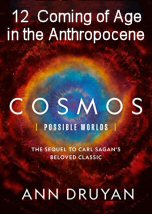
Coming of Age In The Anthropocene

   2020    Nature
At 11 o'clock on New Year's Eve of the Cosmic Calendar, Homo erectus stood up for the first time, freeing its hands and earning the species its name. They began to move around, to explore, daring to risk everything to get to unknown places. Our Neanderthal relatives lived much as we did and did many of the things we consider to be 'human.' More restless than their cousins the Neanderthals and Denisovans, our Homo sapiens ancestors crossed seas and unforgiving landscapes, changing the land, ocean and atmosphere, leading to mass extinction. The scientific community gave our age a new name, 'Anthropocene.'
Since the first civilizations we've wondered if there's something about human nature that contains the seeds of our destruction. Syukuro Manabe was born in rural Japan and took an intense interest in Earth's average global temperature. In the 1960's, he would assemble the evidence he needed to predict the increase of Earth's temperature due to greenhouse gases until it becomes an uninhabitable and toxic environment, leading to our extinction. 'This doesn't have to be,' says Neil deGrasse Tyson, 'it's not too late. There's another hallway, another future we can still have; we'll find a way.'
Series: Cosmos: Possible Worlds

Coronavirus Special Part 2

   2020    Medicine
Dr Chris van Tulleken, Dr Hannah Fry and Michael Mosley examine the latest research and explore some of the big questions about Covid-19 and the pandemic it has created. Michael visits the UK government's high-security laboratory Porton Down, where vaccines are being tested. He also uncovers what the experience of the 2002 SARs epidemic reveals about this one. Both were caused by coronaviruses, but certain key changes to today's virus have allowed it to infect the world, where SARs was contained.
Series: Coronavirus Special

The Last Dance Episode V

   2020    Culture
From Air Jordan and 'Be Like Mike' to the '92 NBA Finals and the Olympic Dream Team, Michael becomes a global cultural icon like any other. But his reputation takes a hit after he refuses to publicly endorse U.S. Senate hopeful Harvey Gantt.
A young Lakers guard named Kobe Bryant makes a big impression at the 1998 NBA All-Star Game and forges a close bond with Jordan.
Series: The Last Dance

The Satanic Verses 30 Years On

   2019    Culture
The publication of Salman Rushdie's novel The Satanic Verses in 1988 sparked a culture war in Britain between those in the Muslim community, who considered the book blasphemous and called for the book to be banned, and those defending it as an expression of freedom of speech. Protests, which began in the north of England, soon spread across the UK and to the rest of the Islamic world, culminating in February 1989 with Iran's Ayatollah Khomeini issuing a fatwa - a death sentence on the writer.
Now, 30 years on, broadcaster and journalist Mobeen Azhar embarks on a journey, starting in his native Yorkshire where the protest first began, to examine the lasting effect the book has had on the Muslim community and how the events of 1989 continue to have an impact today.