Each year more than one million wildebeest and zebra invade the Serengeti grasslands, making it a paradise for the predators that live there. But what happens when the herds move off again? We follow the moving story of one lion family's struggle to survive until the return of the great migration. Nature's Great Events tells the story of the epic trek of herds that follow the rains to fresh pastures, and the tale of the predators they leave behind. The crew captures the desperate plight of a single pride of lions, revealing a different side to the Serengeti. Rather than being a predators' paradise, it is a land in constant change, with wildebeest following the rains and leaving the lions to tough it out. The Ntudu pride has seven cubs, and is already suffering as the wildebeest leave to find fresh pastures. The four pride females struggle to find enough food for their hungry offspring. As weeks turn to months, the pride members become more emaciated and frailer, and the number of cubs dwindles to just two. As the herds begin to return, the plains reveal one final secret. For the first time since 1967 the Serengeti's only active volcano, Ol Doinyo Lengai, begins to billow ash and smoke. Filmed from the air, the team captures the exciting action. Fertilised by the volcanic ash over millions of years, these short grass plains are among the most productive grasslands in the world. After months of hardship, the pride's tragic story, through sickness, drought and fire, is over as the herds return, providing plentiful food.
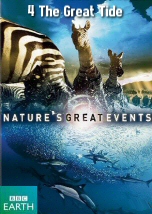
A mighty army of dolphins, sharks, whales, seals and gannets hunt down the billions of sardines along South Africa's east coast each winter. This is the Sardine Run: an underwater Armageddon, the greatest gathering of predators anywhere on the planet, and the most spectacular event in the world's oceans. From intimate moments of the creatures caught up in the run, to the dramatic finale of this spectacular event, The Great Tide is an action-packed feeding-frenzy, filmed underwater, on the ocean's surface, and in the air. However, in recent years the sardine run has become less predictable, perhaps due to the warming effects of climate change. If the sardine run does not happen, the lives of the animals caught up in the drama hang in the balance. Pioneering a unique boat stabilised camera mount for surface filming, Nature's Great Events crew capture all the high octane action as the predators compete for sardines, filmed with aerial, underwater and above water cameras. Super slow motion cameras also capture the very moment gannets plunge into the water, hitting it at sixty miles an hour. A violent winter storm is the trigger for the sardines to begin their desperate dash. They are followed by a super-pod of 5,000 dolphins and further up the coast more predators gather. A shoal of sardines 15 miles long is pushed into the shallows and aerial shots show thousands of sharks gathering to feed on them. The climax to the sardine run is a spectacular feeding frenzy as the dolphins round the sardines up into balls on which all the predators feast. Gannets rain down in their thousands, sharks pile in scattering the fish and a Bryde's whale lunges in taking great mouthfuls of sardines.
The contests between predators and prey are the most dramatic events in nature. Taking an intimate and detailed look at the remarkable strategies employed by hunters to catch their prey and the hunted to escape. Sir David Attenborough narrates. "The Hardest Challenge" reveals the extraordinary range of techniques predators use to catch their prey - from a leopard using all its powers of stealth to stalk impala in broad daylight to wild dogs, whose tactic is to wear down their prey over long distances; from Nile crocodiles, the planet's most patient predators, to killer whales who use teamwork and intelligence to take on humpback whales. But even with these finely tuned strategies, the outcome is far from certain. Surprisingly, most predators fail most of the time.
Fly across iridescent tropical reefs, brush through a cloud of a million jellyfish, visit an alien world where the closer you look, the more you see, where the tiniest creatures support the greatest predators... We think of reefs as exotic, distant places with little or no connection to our everyday world. Yet every reef is a living city beneath the sea with a parallel existence to ours, distant yet undeniably connected. Reefs are hotspots of biodiversity as vital to life on earth as the rain-forests. They have been shaping our shorelines, literally forming islands and mountains, for millions of years. The fossil record shows that given time they have recovered from all of earth's major extinction events. Even reefs pulverised by atomic blasts at Bikini Atoll have regenerated. Yet within our lifetime reefs have come to face their greatest threat...
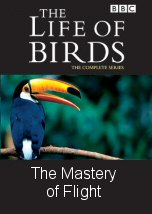
The second programme deals with the mechanics of flight. Getting into the air is by far the most exhausting of a bird's activities, and Sir Attenborough observes shearwaters in Japan that have taken to climbing trees to give them a good jumping-off point. The albatross is so large that it can only launch itself after a run-up to create a flow of air over its wings. A combination of aerodynamics and upward air currents (or thermals), together with the act of flapping or gliding is what keeps a bird aloft. Landing requires less energy but a greater degree of skill, particularly for a big bird, such as a swan. Weight is kept to a minimum by having a beak made of keratin instead of bone, a light frame, and a coat of feathers, which is maintained fastidiously. The peregrine falcon holds the record for being fastest in the air, diving at speeds of over 300 km/h. Conversely, the barn owl owes its predatory success to flying slowly, while the kestrel spots its quarry by hovering. However, the true specialists in this regard are the hummingbirds, whose wings beat at the rate of 25 times a second. The habits of migratory birds are explored. After stocking up with food during the brief summer of the north, such species will set off on huge journeys southwards. Some, such as snow geese, travel continuously, using both the stars and the sun for navigation. They are contrasted with hawks and vultures, which glide overland on warm air, and therefore have to stop overnight.
The fifth programme explores the alliances formed between the animal and plant worlds. Attenborough dives into Australia's Great Barrier Reef and contrasts the nocturnal feeding of coral, on microscopic creatures, with its daytime diet of algae. Some acacias are protected by ants, which will defend their refuge from any predator. Besides accommodation, the guards are rewarded with nectar and, from certain species, protein for their larvae as well. Fungi feed on plants but can also provide essential nutriment to saplings (Mycorrhiza). The connection is never broken throughout a tree's life and a quarter of the sugars and starches produced in its leaves is channelled back to its fungal partners. Meanwhile, fungi that feed on dead wood leave a hollow trunk, which also benefits the tree. Orchids enjoy a similar affiliation. Lichens are the product of a relationship between fungi and a photosynthetic associate, usually algae. They are extremely slow-growing, and a graveyard is the perfect location to discover their exact longevity. Mistletoe is a hemiparasite that obtains its moisture from a host tree, while using own leaves to manufacture food. Its seeds are deposited on another by the mistletoe tyrannulet, following digestion of the fruit. The dodder (Cuscuta) is also parasitic, generally favouring nettles, and siphons its nourishment through periodic 'plugs' along its stem. The rafflesia has no stem or leaves and only emerges from its host in order to bloom — and it produces the largest single flower: one metre across.






















The crew captures the desperate plight of a single pride of lions, revealing a different side to the Serengeti. Rather than being a predators' paradise, it is a land in constant change, with wildebeest following the rains and leaving the lions to tough it out. The Ntudu pride has seven cubs, and is already suffering as the wildebeest leave to find fresh pastures. The four pride females struggle to find enough food for their hungry offspring. As weeks turn to months, the pride members become more emaciated and frailer, and the number of cubs dwindles to just two. As the herds begin to return, the plains reveal one final secret. For the first time since 1967 the Serengeti's only active volcano, Ol Doinyo Lengai, begins to billow ash and smoke. Filmed from the air, the team captures the exciting action. Fertilised by the volcanic ash over millions of years, these short grass plains are among the most productive grasslands in the world. After months of hardship, the pride's tragic story, through sickness, drought and fire, is over as the herds return, providing plentiful food.