










Last Watched

"Predator"  Sort by

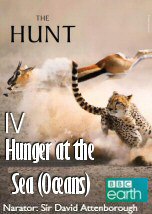
Hunger at Sea

   2015    Nature
Hunger at Sea follows blue whales, sharks, sea lions, frigatebirds, dolphins and albatrosses to reveal the strategies they use to hunt for prey in the big blue. The open ocean is an immense wilderness that covers more than half the surface of our planet, yet for the most part it's a watery desert, largely devoid of life. Predators face an endless search to find and catch food, yet these great tracts of ocean are home to some of the most remarkable hunters on the planet.
Series: The Hunt
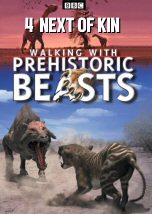
Next of Kin

       Science
Moving on to Ethiopia 3.2 million years ago, we witness the beginnings of mankind via a group of australopithecus - a type of ape which, like us, walks upright on two legs. But unlike us, these early members of the human family weren't predators, they were prey. Things get worse for the group as they are hunted by a sabre-tooth cat called dinofelis and fall victim to other dangers such as malaria, rival australopithecus and a rampaging 14-tonne deinotherium.
Series: Walking with Prehistoric Beast

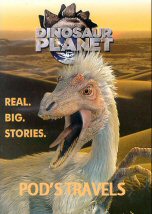
Dinosaur Planet: Pod Travels

   2003    Science
SETTING: 70 million years ago in Europe, near present-day Romania. Pod, a male pyroraptor, is alone in the world after his sisters die in a tidal wave that sweeps him out to sea. After landing on an island populated with dwarf-sized dinosaurs, Pod discovers that he's become the apex predator. But, Pod learns it's lonely at the top.
Series: Dinosaur Planet

Big Blue

   2017    Nature
The big blue is the world's greatest wilderness, far from shore and many kilometres deep. It's a vast marine desert where there is little to eat and nowhere to hide. Yet it's home to some of the biggest and most spectacular creatures on earth. This episode reveals what it takes to survive in this savage and forbidding world. We witness feats of incredible endurance, moments of high drama and extraordinary acts of heart-wrenching self-sacrifice. Every animal in the big blue must find their own unique way to survive. Sperm whales have the largest brains in the world. They live for 80 years, and we are only now beginning to learn the extraordinary complexity of their language of clicks - thought to coordinate the whole family in everything from childcare to hunting. With special pressure-proof cameras, we witness record-breaking feats of endurance as they hunt for squid a kilometre down into the abyss. Only recently have we begun to solve the mystery of where baby turtles disappear to in their early years. They leave the crowded waters of the coast and head to the open ocean, where they use floating debris like logs as life rafts. Here they remain until adulthood, adrift on the high seas in relative safety away from coastal predators. Over half of all animals in the open ocean drift in currents. Jellyfish cross entire oceans feeding on whatever happens to tangle with their tentacles. The jelly-like Portuguese man-of-war can harness sail power to fish with its deadly tentacles. Sometimes there is a brief explosion of food in this marine desert, but ocean hunters must be fast to make the best of this bonanza. We witness super pods of up to 5,000 spinner dolphins racing to herd vast shoals of lanternfish, briefly caught at the surface where it is thought they spawn. New aerial footage reveals, for the first time, the truth to a centuries-old sailors' legend of the 'boiling seas' - the spectacular feeding frenzy of 90kg tuna and dolphins smashing through the lantern fish shoals turning the sea white with foam.
Series: Blue Planet II

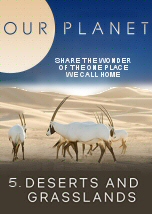
Nowhere to Hide

   2015    Nature
The open arenas of grassland and desert make up half of all land on our planet. In these exposed habitats, predators like cheetahs, bald eagles and lions can usually see their prey. But it works both ways: their prey can see them too. With nothing but open vistas, the element of surprise is hard-won, and predators must make their own opportunities.
Series: The Hunt

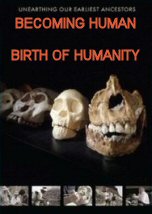
Birth of Humanity

   2010    History
We will nvestigate the first skeleton that really looks like us –Turkana Boy– an astonishingly complete specimen of Homo erectus found by the famous Leakey team in Kenya. These early humans are thought to have developed key innovations that helped them thrive, including hunting large prey, the use of fire, and extensive social bonds. The program examines an intriguing theory that long-distance running –our ability to jog– was crucial for the survival of these early hominids. Not only did running help them escape from vicious predators roaming the grasslands, but it also gave them a unique hunting strategy: chasing down prey animals such as deer and antelope to the point of exhaustion. Birth of Humanity also probes how, why, and when humans' uniquely long period of childhood and parenting began.
Series: Becoming Human
Dark Net

Dark Net

2016  Technology
Secrets of the Dead

Secrets of the Dead

2017  History
Zeitgeist

Zeitgeist

2007  Culture
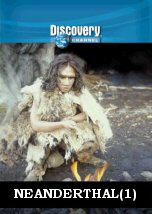
Neanderthal

Neanderthal

  History
Universe

Universe

2021  Science
High Score

High Score

2020  Technology
The Crime of the Century

The Crime of the Century

2021  Medicine
Top Gear

Top Gear

2012  Technology